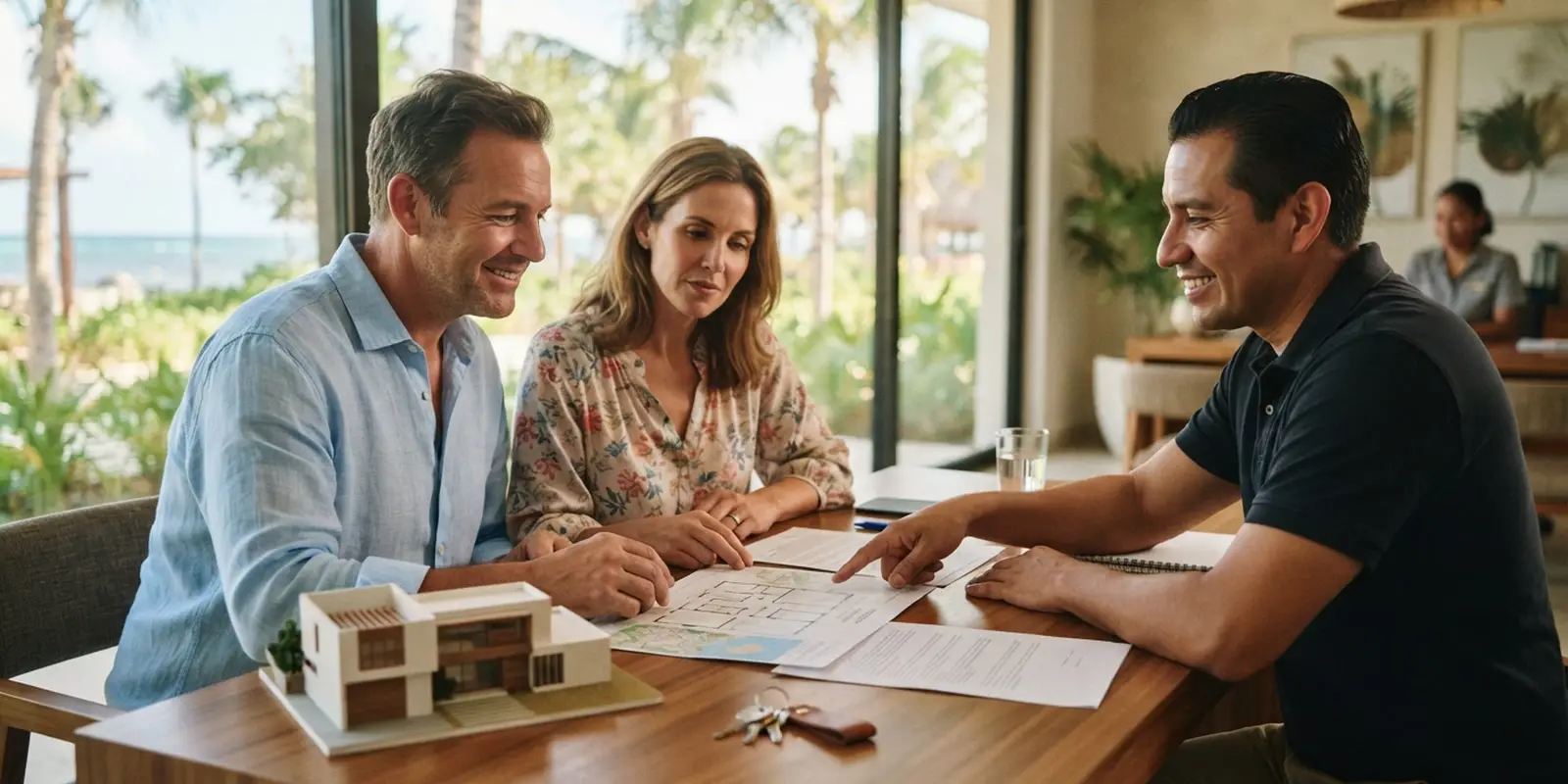
The short answer: you can buy without Spanish, but you'll sign in Spanish
The Riviera Maya real estate market is built around foreign buyers. Agents in Playa del Carmen and Tulum work in English, developers publish brochures in English, and plenty of closings happen where the buyer never says a word of Spanish beyond gracias.
Here's the part the brochures skip: the documents that actually transfer ownership are in Spanish, and only the Spanish version has legal force. The purchase agreement, the deed (escritura), the trust documents if you're buying in the restricted coastal zone, the notary's file, all of it. An English translation may be provided as a courtesy, and it is exactly that: a courtesy. If the translation and the Spanish original ever disagree, the Spanish controls.
That single fact reframes the question. You're not deciding whether to learn Spanish so you can do the deal yourself; almost nobody does that, and you shouldn't either. You're deciding how much of the process you want to understand with your own eyes versus how much you're willing to take entirely on trust.
One thing before we go further: nothing in this article is legal advice. We teach languages; we don't structure real estate deals. For the transaction itself you want a licensed bilingual real estate lawyer and a notary, full stop. What we can tell you, from years of teaching Spanish to expats who bought here, is exactly where the language gap shows up and what it feels like from the buyer's chair.
Where the language gap actually bites: the notary's office
In Mexico, the notario público is nothing like a notary back home. It's a highly regulated legal role: the notario drafts the deed, verifies title, calculates taxes and formalizes the transfer. No notario, no sale.
And the notario's world runs in Spanish. The reading of the deed at closing is done in Spanish. The questions you're asked are in Spanish. If you don't understand the language, Mexican practice is that a translator or interpreter participates so you know what you're signing, which is a good safeguard, and also a moment worth thinking about honestly: you are signing the largest purchase of your life based on someone else's real-time summary.
Buyers who've studied even a few months of Spanish describe that room completely differently. They catch the clause numbers as they're read. They recognize words like gravamen (lien), predial (property tax), avalúo (appraisal), enganche (down payment). They can ask the notario to slow down, ¿puede repetir, por favor?, and actually follow the answer. None of that replaces the lawyer. All of it changes how much you understand of your own transaction.
Misunderstandings in a purchase this size rarely come from malice. They come from small things lost between languages: a date, a condition, an assumption each side thought was obvious. A missed detail about who pays which closing cost, or when possession actually transfers, can turn into weeks of friction. Every bit of Spanish you bring into that room shrinks the space where those misunderstandings live.
Ready to actually speak?
Take the placement test and start at exactly your level. In person in Playa del Carmen or Tulum, or live online.
Buying in the Riviera Maya? Take a free placement test and start your Spanish before closing dayBefore closing: hunting, negotiating and reading between the lines
The months before the notario are where Spanish quietly pays for itself.
- Talking to more than the listing agent. The doorman, the neighbor, the guy at the tiendita on the corner: these people know whether the street floods in September, whether the building has water problems, what the neighborhood sounds like at 2 a.m. That intel is available in Spanish, casually and for free, to anyone who can hold a five-minute conversation.
- Negotiating with owners directly. Not every property in Playa del Carmen or Tulum is listed in English. Some of the interesting deals, especially resales in established neighborhoods, circulate in Spanish first: a sign in a window, a Facebook post, a comment at the market.
- Understanding what your own team is saying. Your agent, your lawyer and the seller's side will talk to each other in Spanish, in front of you. Buyers who understand nothing describe the eerie feeling of watching their own negotiation happen as theater. Buyers who understand even partially can tell when the summary they get afterward matches what was actually said.
None of this requires fluency. Intermediate comprehension, understanding more than you can produce, is the realistic and genuinely useful target for a property search. It's also, not coincidentally, the level most motivated adults can reach with consistent study during exactly the six to twelve months a typical property hunt takes.
After the keys: where Spanish stops being optional
Here's what the transaction-focused advice misses: the closing is one day; owning the place is every day after. And ownership in Mexico runs almost entirely in Spanish.
- Utilities. Setting up or transferring CFE (electricity), water, internet. Phone menus, service visits, the technician calling to say he's outside: Spanish.
- Contractors and maintenance. Plumbers, electricians, the albañil fixing your roof before rainy season. Explaining what's wrong, agreeing on a price and a date, understanding what was actually done: Spanish. This is the single area where new owners tell us the language gap costs them real money.
- The condo association. If you bought in a building, HOA meetings, assemblies, votes on fees and rules happen in Spanish. Owners who can't follow them simply lose their voice in decisions about their own property.
- Property managers, accountants, banks. Even with bilingual staff, the paperwork underneath is in Spanish.
And if you're planning to rent the place out, the vacation-rental economy adds its own layer: coordinating cleaners, handymen and pool maintenance, resolving a guest's broken air conditioner at 9 p.m., dealing with the building administrator about noise complaints. Property managers will handle it for a fee, but owners who can pick up the phone themselves consistently report faster fixes and better relationships with the people who keep their investment running.
This is why the honest answer to "do I need Spanish to buy" is really two answers. For the purchase: no, professionals bridge the gap. For the life you bought the property to live: you'll want it, sooner than you think. Buyers who start Spanish when they start house hunting arrive at the keys with the daily-life toolkit already working.
How much Spanish is enough, and a realistic way to get there
Let's put numbers on it without overpromising. Spanish is one of the easiest languages for English speakers: the U.S. Foreign Service Institute classifies it as Category I, with professional working proficiency estimated at roughly 600 to 750 class hours. You don't need anywhere near that for property ownership. What you need first is transactional Spanish: numbers, prices, dates, describing a problem, understanding an answer, and the rescue phrases (más despacio, por favor) that keep a conversation alive.
A practical sequence that matches the buying timeline:
- During the search (months 1–4): survival and transaction Spanish. Prices, appointments, directions, small talk that opens doors.
- Toward closing (months 4–8): the vocabulary of the deal itself, so the words in the notario's office aren't noise: escritura, predial, avalúo, mantenimiento.
- After the keys: the contractor-and-neighbor register, which is where Spanish turns from safety net into actual life.
We're a language school founded in 2019, with campuses in Playa del Carmen (Calle 72) and Tulum, and we teach Spanish for foreigners in small groups: in-person twice a week in two-hour sessions, a four-hour Saturday format, or live online if you're still buying from abroad. The program runs in four-month modules, you take a free placement test, and you only take the levels you need. Most buyers don't need many. They just need to start before closing day, not after.
Your free trial class is waiting
Visit the school, take your placement test and see why at Idiomarcui you speak from day one.
Buying in the Riviera Maya? Take a free placement test and start your Spanish before closing dayFrequently asked questions
Can I legally buy property in Mexico without speaking Spanish?
Yes. Foreigners buy in Playa del Carmen and Tulum constantly through bilingual agents, lawyers and notaries, with an interpreter at closing if needed. But the binding documents are in Spanish, and only the Spanish version has legal force, so trustworthy bilingual professionals are essential.
Are property contracts in Mexico available in English?
You'll often receive an English translation as a courtesy, but it's just that. The deed and purchase documents that legally transfer ownership are in Spanish, and if the versions ever disagree, the Spanish original controls.
What is a notario público and why does it matter?
A Mexican notario is a specialized legal official, far beyond a US-style notary: they draft the deed, verify title and formalize the transfer. No sale closes without one, and the entire notarial process, including the reading of the deed, happens in Spanish.
What Spanish words should I know before closing on a house?
Start with escritura (deed), predial (property tax), avalúo (appraisal), gravamen (lien), enganche (down payment) and mantenimiento (HOA/maintenance fee). Recognizing these as the deed is read aloud changes how much of your own closing you understand.
How long before buying should I start learning Spanish?
Ideally when you start the search. A property hunt typically takes months, which is enough time for consistent study to get you to useful transactional Spanish by closing day, and functioning daily-life Spanish by the time you're dealing with utilities and contractors.