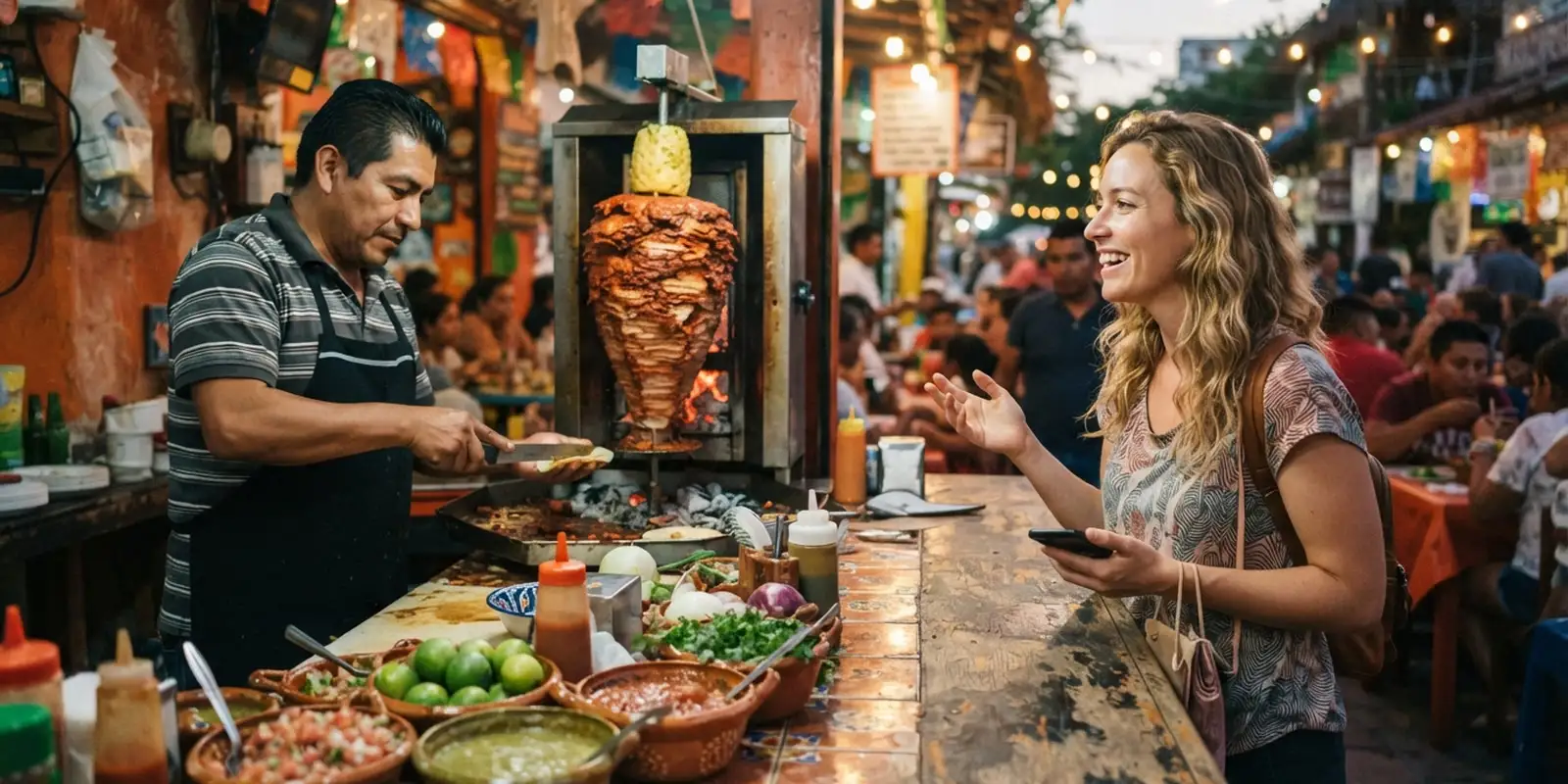
The three phrases that order ninety percent of your meals
Forget memorizing scripts for every situation. Mexican food ordering runs on three flexible structures, and everything else is vocabulary you plug into them.
- ¿Me da...? (meh DAH) — literally "do you give me...?", functionally "can I have...?". This is the workhorse at taquerías, market stalls and counters. ¿Me da tres tacos de pastor? Friendly, normal, exactly what locals say. A softer variant you'll hear constantly: ¿Me regala...? (meh reh-GAH-lah), literally "will you gift me...", which is just polite ordering, nobody expects it free.
- Quisiera... (kee-SYEH-rah) — "I would like...". Your sit-down restaurant register. Quisiera el pescado a la plancha, por favor.
- ¿Qué me recomienda? (keh meh reh-koh-MYEN-dah) — "what do you recommend?". The single highest-value phrase in this article. It hands the conversation to the waiter or the taquero, who almost always knows what's best that day, and it signals respect: you came to eat what they're proud of.
Drinks come first, so expect ¿Algo de tomar? (AHL-goh deh toh-MAHR — "something to drink?") before you've opened the menu. Useful answers: una limonada, un agua de jamaica (hibiscus water, ah-gwah deh hah-MY-kah), agua natural (still water) or agua mineral (sparkling). If ice is a concern, sin hielo (seen YEH-loh) settles it in two words.
Two support phrases keep everything running: por favor and gracias, non-negotiable in Mexico, where courtesy words carry real social weight, and the rescue phrase más despacio, por favor (mahs dehs-PAH-syoh — "slower, please") for when the answer comes back at full speed. Nobody minds. They'll slow down and often smile that you're trying.
Taquería Spanish is its own dialect. Here's the decoder
Your first solo taquería visit comes with rapid-fire questions. Here's what they mean and what to answer.
- ¿Con todo? (kohn TOH-doh) — "with everything?", meaning onion and cilantro. Yes: sí, con todo. No: sin cebolla (no onion, seen seh-BOH-yah) or sin cilantro.
- ¿Para aquí o para llevar? (PAH-rah ah-KEE oh PAH-rah yeh-VAHR) — for here or to go.
- ¿De qué los quiere? — "what kind?". Know your fillings: pastor (marinated pork off the spit), bistec (beef), carnitas (slow-cooked pork), pollo (chicken), cochinita pibil (Yucatecan achiote pork, the regional star here in Quintana Roo).
- Orden — an order, usually a set of tacos of one type. Una orden de pastor y dos de bistec sueltos (sueltos = individual tacos outside a set).
- ¿Salsa verde o roja? — green or red. Useful survival question back: ¿cuál pica menos? (kwahl PEE-kah MEH-nohs — "which one is less spicy?"). Take that question seriously; Mexican "no pica" is calibrated differently than yours.
Pro move: at a busy stand, watch one round of locals ordering before you step up. The rhythm, the quantity words, the salsa etiquette, who pays when: two minutes of observation teaches you more about real ordering than an app does in a month, and it buys you time to rehearse your own line.
Ready to actually speak?
Take the placement test and start at exactly your level. In person in Playa del Carmen or Tulum, or live online.
Learn the Spanish you'll actually use at the table — book your free placement test and trial classMarkets and street food: buying by weight and asking for tastes
The mercado is the best free Spanish classroom in Mexico, and it has its own grammar: quantities.
- Un kilo / medio kilo / un cuarto — a kilo, half kilo, quarter kilo. ¿Me da medio kilo de tortillas? is a sentence you'll use weekly for the rest of your life here.
- ¿A cómo...? (ah KOH-moh) — the market way to ask a price. ¿A cómo el kilo de mango? Locals use this more than ¿cuánto cuesta? at stalls.
- ¿Me deja probar? (meh DEH-hah proh-BAHR) — "can I taste?". At fruit stands this is normal and often offered before you ask.
- ¿Está dulce? ¿Está maduro? — is it sweet? is it ripe? Asking which mango to take para hoy (for today) versus para la semana gets you visibly better fruit.
Numbers are the real gatekeeper. Prices come back fast, cuarenta y cinco, ciento veinte, and if you freeze, everyone defaults to fingers or a calculator screen, which works but keeps you a tourist. Drilling numbers to automatic is the single fastest upgrade to your market experience, and it's one of the first things any decent beginner course hammers precisely because daily life here runs on them.
One cultural note: haggling at food stalls is not really a thing. Prices are honest and thin-margin. Save negotiation for artesanía markets, never for the señora selling fruit. What does work wonders is loyalty: greet your regular vendors by name, and watch the ripest fruit and the occasional free taste start finding their way to you.
Allergies and dietary needs: the Spanish that has to be exact
This is the section to actually memorize, because "more or less" doesn't cut it when your health is involved.
- Soy alérgico/alérgica a... (soy ah-LEHR-hee-koh/kah) — "I'm allergic to...". Key vocabulary: los cacahuates (peanuts), las nueces (tree nuts), los mariscos (shellfish), el huevo (egg), los lácteos (dairy), el gluten.
- ¿Esto tiene...? (EHS-toh TYEH-neh) — "does this have...?". Ask it even when you think you know. Mexican kitchens use lard (manteca), broth bases and nut-thickened sauces in places you won't expect; mole, for example, commonly contains peanuts or almonds.
- Soy vegetariano/vegetariana · Soy vegano/vegana · No como carne — say the last one too, because in casual spots "meat" sometimes means beef specifically, and chicken or ham may not register as carne. ¿Está preparado con manteca o con caldo de pollo? (is it made with lard or chicken broth?) is the question vegetarians actually need.
- Sin picante, por favor — no spicy. Separate concept from sin salsa; the marinade itself can carry heat, so ask ¿pica? about the dish, not just the salsa.
Written cards help as backup, but restaurants respond far better to a spoken sentence plus a follow-up question. If you can say the allergy, hear the answer and confirm, ¿seguro que no tiene?, you've reached the level of Spanish that isn't a party trick anymore. It's safety equipment.
The check, the tip and the goodbye: finishing like you live here
Meals in Mexico end differently than up north, and the differences are where expats most visibly out themselves.
- The check won't come until you ask. This isn't slow service; it's courtesy. Bringing the bill unasked is considered rushing you out. When ready: la cuenta, por favor (lah KWEN-tah), or the universal air-signature gesture from across the room, which is completely acceptable.
- Tipping: la propina. In sit-down restaurants a tip of around ten to fifteen percent is customary, a bit more for great service. At taquerías and market stalls it's not expected, though rounding up or leaving coins is always welcome. If paying by card, the terminal comes to your table, and the waiter may ask ¿con propina?, tell them the amount or percentage to add. Cash tips left on the table work everywhere.
- ¿Todo bien? — "everything good?" mid-meal. The answer is todo bien, gracias or, better, todo delicioso.
- Provecho. (proh-VEH-choh) The word with no English equivalent: said to people who are eating or about to, including strangers as you pass their table on your way out. Saying it back, or first, is one of those tiny signals that you're not just visiting the culture but joining it.
Every phrase in this article works better out loud than on the page. If you want them drilled into reflexes, with a teacher correcting your pronunciation before the taquero has to, our Spanish courses in Playa del Carmen and Tulum run in small groups twice a week, with a free placement test to find your level. First field trip: tacos. Obviously.
Your free trial class is waiting
Visit the school, take your placement test and see why at Idiomarcui you speak from day one.
Learn the Spanish you'll actually use at the table — book your free placement test and trial classFrequently asked questions
What's the most polite way to order food in Spanish?
"Quisiera... por favor" (kee-SYEH-rah — "I'd like...") in restaurants, or "¿Me da...?" (meh DAH) in casual spots. Both are polite and natural. Adding "por favor" and "gracias" matters more in Mexico than the exact verb you choose.
What does "¿con todo?" mean at a taquería?
"With everything?", which at a taquería means onion and cilantro. Answer "sí, con todo" to accept, or "sin cebolla" / "sin cilantro" to skip one. Salsa is a separate decision you make at the salsa bar or when they ask "¿verde o roja?".
How do I say I have a food allergy in Spanish?
"Soy alérgico a..." (men) or "soy alérgica a..." (women), then the food: cacahuates (peanuts), mariscos (shellfish), lácteos (dairy), gluten. Always double-check with "¿esto tiene...?" (does this have...?), since lard, broths and nut-based sauces hide in unexpected dishes.
How much do you tip at restaurants in Mexico?
Around ten to fifteen percent is customary at sit-down restaurants, more for great service. Taquerías and market stalls don't expect tips, though rounding up is appreciated. Ask for the check with "la cuenta, por favor", it won't come until you request it.
What does "provecho" mean and when do I say it?
It's a courtesy wish meaning roughly "enjoy your meal", said to anyone eating or about to eat, even strangers at other tables as you leave. There's no real English equivalent. Reply with "gracias" or say it back. Using it naturally is a small badge of belonging.